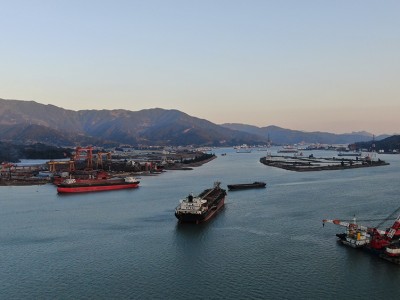
SOME locals in the port town of Gladstone recall swimming and catching mud crabs off Curtis Island in the city’s harbour. The harbour is now undergoing the biggest dredging operation ever approved in Australia. From 2014, huge ships are due to load liquefied natural gas (LNG) from Curtis Island for export, mainly to Asia. Mud crabs, fish and other seafood have erupted in lesions, red spots and other signs of sickness.
柯蒂斯岛(Curtis Island)距格莱斯顿港不远。这座港城的一些当地居民还能回忆起在港口对面的岛上游泳和抓膏蟹的情景。这个港口眼下正在进行澳大利亚历史上规模最大的疏浚作业。这项工程得到了政府的批准。从2014年开始,大型船只将从柯蒂斯岛上装载液化天然气出口,主要是输往亚洲国家。这片海域的膏蟹、鱼类及其他海产品已经爆发了疫病,普遍长有红色斑点,而且还有患其他疾病的迹象。
Gladstone harbour lies within the World Heritage Area of the Great Barrier Reef, an area the size of Italy stretching along the coast of Queensland. It was listed as a heritage site for its coral reefs, seagrass habitats and rare marine species, but worries about the impact of the harbour’s rapid industrial development led to a recent visit by UNESCO experts. They are due to issue their report in late June.
格莱斯顿港位于大堡礁这个世界自然遗产保护区内。大堡礁沿昆士兰海岸绵延开来,大小相当于意大利的国土面积。由于其珊瑚礁、海草栖息地与珍稀海洋生物而被列入世界遗产保护地名录。但由于担心这个港口快速的工业化发展而产生的负面影响,一组联合国教科文组织的专家最近对这里进行了考察。预计他们将在6月底提交考察报告。
The harbour at Gladstone already hosts an aluminium smelter and a coal-export terminal. But Australia’s coal-seam gas boom inland is changing its face. Three consortia involving BG Group, a British company, and Santos and Origin Energy, both Australian, are each building on Curtis Island what will be the world’s first plants to turn gas drilled from coal seams into LNG for export. A fourth plant is planned.
格莱斯顿港已经有一家铝冶炼厂和一个煤炭装运港了。但澳大利亚内陆地区煤层气工业蓬勃发展的局面正在改变这个港口的面貌。由英国天然气集团(BG Group)与桑托斯公司(Santos)和原产能源有限公司(Origin Energy)这两家澳大利亚公司等投资的三家合资企业都正在柯蒂斯岛上进行建设。这是世界上第一批将开采出的煤层气转化成液化天然气(LNG)的工厂,生产出的液化天燃气都将出口。这里正在规划建设第四家这类工厂。
Seafood businesses commissioned Matt Landos, a veterinary scientist, to investigate outbreaks of sickness that have appeared among the harbour’s abundant marine life. His report in April detailed how creatures he caught in the harbour suffered skin ulcers, diseased fins and damaged intestines. Mr Landos blamed toxic metals and sediment from earlier industrial pollution that had settled on the harbour bed and was being stirred up by dredging.
海产食品商们委托兽医学专家马特•兰德斯(Matt Landos)前往调查这个港口海域中大量水生动物突然爆发疫病的事件。他在四月份发表了调查报告,详述了他在这个港口海域中捕获的水生动物患有皮肤溃疡、烂鳍和肠道损伤的情况。兰德斯认为,造成水生动物疫病爆发的罪魁祸首是有毒的重金属和沉积物。这些有毒物质来源于以往排放的工业污染物。这些有毒物质本已沉积到了港口海域的海底,但现在由于疏浚作业而被搅翻起来。
Leo Zussino, the head of the Gladstone Ports Corporation, a state body, rejects this analysis. He says “all the evidence” links the outbreaks to vast freshwater flows from floods and cyclones that lashed Queensland in early 2011; “generational change” to the harbour’s salinity level followed. Mr Zussino blames sickness in the harbour’s barramundi, a local fish, on stress from invasions by freshwater barramundi during the floods. “Science will win in the end,” he says.
莱昂•祖西诺(Leo Zussino)是格莱斯顿港口公司(一家州属企业)的首席执行官。他不同意上述分析。他说,“所有证据”都表明这场疫病的爆发与2011年初横扫昆士兰的那场热带气旋与肆虐的洪水有关。当时大量的淡水涌入这片海域,使海水的含盐量“产生变化”。祖西诺认为,生活在这片海域的巴拉蒙达鱼患病的原因主要是由于洪水期间大量淡水巴拉蒙达鱼的入侵使它们精神紧张所致。他说:“科学会自有公断的。”
Whatever the cause, the outbreak has devastated Gladstone’s once-thriving seafood industry. Ted Whittingham, who runs a local wholesale seafood business, has stopped buying fish, prawns and crustaceans caught in the harbour, which he says has been destroyed as a habitat for sea life. He estimates losses to local fishermen at A$36m ($35m) a year.
无论原因是什么,这场疫病的爆发给格莱斯顿以往兴盛的海产业带来了毁灭性的打击。泰迪•惠廷汉姆(Ted Whittingham)是本地一位经营海产品的批发商,他已经停止了收购在这片海域捕获的鱼、虾和甲壳类动物。他说这片海域已经被毁了,不适合作为海水生物的栖息地了。他估计本地渔民每年的损失高达3600万澳元(3600万美元)。
The UNESCO visit in March was prompted partly by the World Heritage Committee’s concern that the Australian and Queensland governments had failed to notify it before they approved the Curtis Island LNG plants. Visiting Gladstone recently, Queensland’s state-development minister said the “whole Great Barrier thing” was “overdone”. Mr Zussino goes further. He reckons Gladstone is destined to be Australia’s “industrial powerhouse of the eastern seaboard”, and the development is too important to slow or stop. He suggests moving the boundary of the world heritage area to exclude Gladstone. “We don’t care where the boundary is,” he says.
澳大利亚与昆士兰州政府在批准于柯蒂斯岛上建设液化天然气工厂前并没有进行申报,因而引起了世界遗产委员会的关注,并促成了联合国教科文组织5月份对这里的考察。最近,昆士兰州发展部长对格莱斯顿进行了视察。他说:“对整个大堡礁的担忧”有些“过虑了”。祖西诺先生就说得更直接了。他预计格莱斯顿注定要成为澳大利亚“东部沿海地区工业发展的发动机”。这个地区的发展太重要了,因此不可能
来源:经济学人